
Sin City
Amsterdam – the capital of the Netherlands – is the largest city in the country, where everyone will find a lot of interesting things for themselves, for the sake of which they would not come here. See the city weirdos – please. Visit the Van Gogh exhibition – welcome. And no one will condemn here a traveler who wants to look at the inhabitants of the red light quarter. This is as much a city attraction as others.
Traveling through the city, famous for its many channels, is difficult to imagine without a boat cruise. This is a bright and memorable excursion, the impressions of which can be enhanced by visiting the Maritime Museum. Favorite place of rest, meetings and parties of citizens and guests of Amsterdam – Leiden Square (Leidseplein). There are many cafes, shops and souvenir shops. A real divide for tourists! Go to the Flower Market. Not only seeds and bouquets are sold here, but also souvenirs, and even cheese. Bring with you a couple of bulbs of Dutch tulips to remember the trip. After all, this is the country’s calling card. And if you are a fan of piquant entertainment, go to the Museum of Sex. Surely you will hear not only historical facts, but also bring a lot of new knowledge for yourself. And be sure to rise to the observation deck in order to look at the whole beautiful Amsterdam at once, which will now remain with you for a long time.
Сity of the future
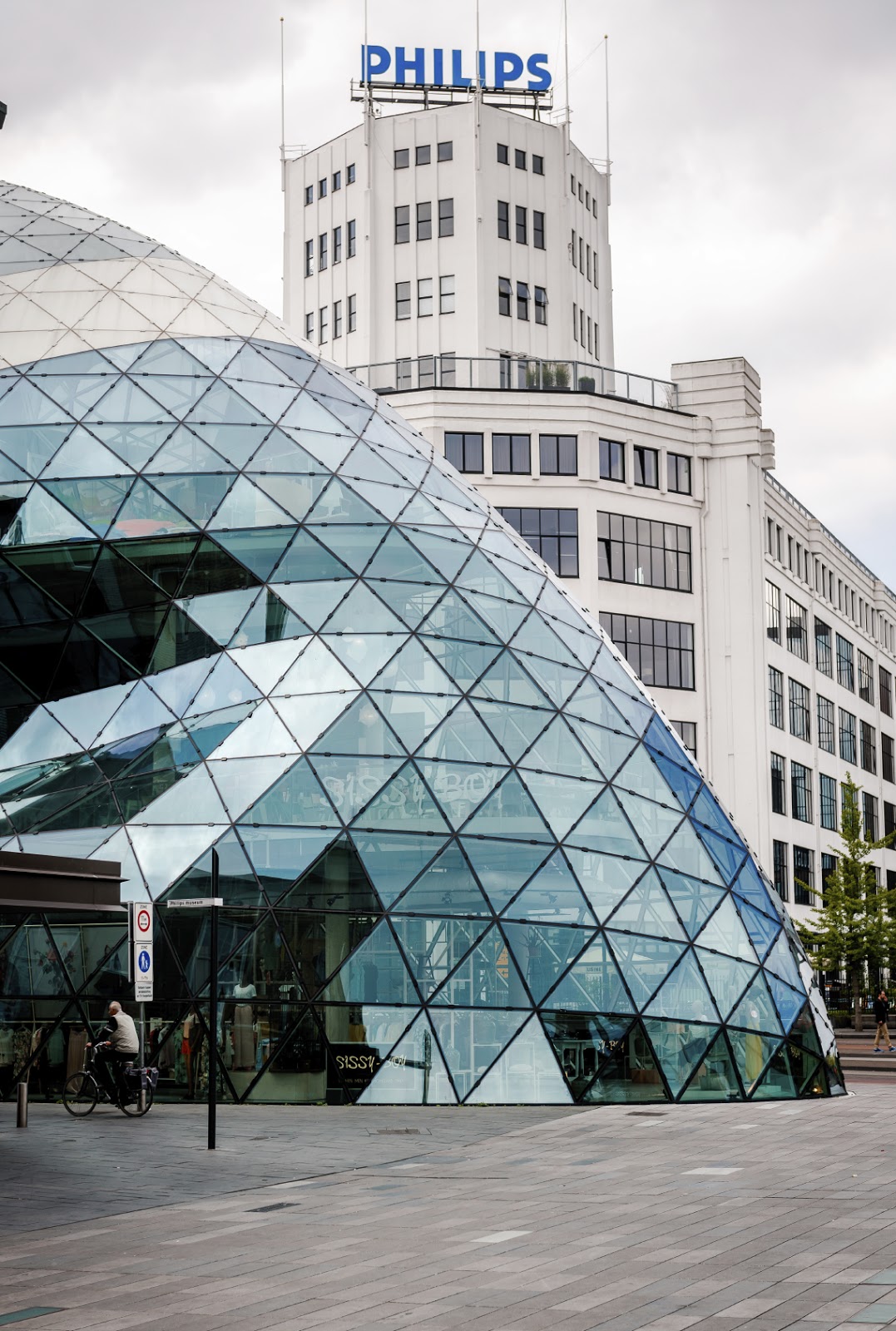
Dutch Eindhoven can be called one of the most modern projects in Europe without exaggeration. Symptoms of the “city of the future” appeared here at the beginning of the 20th century thanks to Phillips, who in 1891 founded a light bulb factory here. After that, high-tech companies pulled in, thanks to which design and innovative projects now remain part of the everyday life of citizens. Here they equip “green” stops, cover the roofs with solar panels, save heat in every possible way and drive high-speed buses along dedicated routes.
One of the main attractions of Eindhoven is the PSV Museum – the saint of the holy fans of the famous Dutch football club, founded in 1913. It is located at Phillips Stadium, which is the home arena of PSV. The most interesting place is the Hall of Fame, where Romario and Jan van Beveren items, rare photos, videos, champions cups are exhibited. Interactive entertainment is organized for children, it is possible to play a team on a team directly on the football field. We strongly recommend to guess the time of the visit and get on a tour of the stadium (by advance appointment on the website of the museum https://www.psv.nl), which takes place daily from Monday to Saturday and begins at 13.00, and on Wednesday and Saturday also at 14.30. Another exciting excursion in Eindhoven is also associated with the city-forming company. The Phillips Museum opened very recently – April 5, 2013. Right now there is an interactive exhibition “90 years of design,” which shows how various devices produced by the Dutch concern have evolved and literally stepped in step with time. Visitors can play an interactive game (from 2 to 4 participants), during which it will be necessary to pass quests and collect puzzles, while studying what light, spectrum and different types of waves are. Also in the city should visit the private museum of trucks DAF. Here are assembled multi-caliber tractors and modest small tractors, the production of which in 1975 was sold to the Volvo auto giant.
In the morning we recommend going to the ancient city of Asten (go there by car for 30 minutes), next to which are the ruins of the castle of the same name. It was first mentioned in the annals in 1399 and was originally a small building, but by 1600 it had turned into a flowering estate. They say that the Spanish Inquisition, which was rampant in Flanders and Brabant, contributed a lot to the enrichment: many witches, sorcerers and heretics were tortured in the basements of the castle, whose property also went to the treasury of the owners. For a long time Asten lay in ruins, now it has been partially restored. On the way back to Eindhoven, you can turn into the village of Van Gogh – Nuenen, where he spent the first years of his life already in the status of an artist. Here the great painter painted ordinary people and farms. According to art historians, the blue and brown tones in the master’s paintings are characteristic of this period. Here, by the way, the Potato Eaters were born, as well as the canvas “Exit from the Protestant Church in Nuenen,” which was stolen in 2002 from the Van Gogh Museum in Amsterdam and has not yet been found. Learn more about the life of the artist in the province at the Documentary Center. Here they will tell the route to the surroundings associated with the work of the master. The path is… 51 kilometers to the very places where Van Gogh created almost a quarter of his masterpieces. It starts from the Vincentre Museum, and one of its most interesting sites is located near Nuenen. This is a bicycle path with stones glowing in the dark – a project of the design studio Studio Roosegaarde, which took as the basis the famous artist’s painting “Starry Night.”
It is worth visiting the church of St. Catherine, which is located in the very center of the city. This neo-Gothic temple was built not so long ago – in 1867, although it is known from sources that the first cathedral on this site stood in 1240. It is unlikely Sint‑Catharinakerk can strike with architecture. However, here are very beautiful stained glass windows that appeared after the Second World War, when the church, which suffered from the bombing, was restored. After that, go to the Eindhoven Museum – an open-air exposition where you can easily spend half a day. “Medieval” artisans, traders and peasants work here, who gladly share secrets, how to bake bread, forge horseshoes and nails, tie themselves to a shameful pillar. Also from his expositions you can learn a lot about the cultural life of the Brabant region, through which the Spanish Inquisition passed with fire and sword in the Middle Ages. By the way, until the end of December, the museum hosts the exhibition “Her City,” which talks about the role of women in the development of industry between the two world wars, that “golden age,” when Einkhoven was on the rise. And for the evening leave a visit to the most beautiful castle in the vicinity – Henkenscheg, located 17 kilometers from the city. In the XIV century, it was built as a fortress on the island and surrounded by a moat with water, and then turned into an ordinary estate. Today they conduct excursions and arrange weddings.

Port city
The second largest city in the Netherlands. Its name was coined according to the same scheme as the name of the capital: Rotterdam means “dam on the Rotter River.” The city is beautiful, cozy, calm and neat – real, whatever it is, Europe. At the same time, it is one of the largest ports in the world: each year more than 30 huge sea and almost 180 thousand river vessels are anchored and unloaded here. Rotterdam falls asleep under port beeps, wakes up under the scratch of port cranes. The Dutch even joke that they spend money in Amsterdam, and in Rotterdam they earn it.
Rotterdam’s tolerance is expressed in the fact that a third of the townspeople are of non-Dutch origin. Moreover, the largest Western European mosque is located here – it was opened in 2010, ignoring the obstruction of right-wing radicals. The final touch to the democratic appearance of the city is the election of a Dutch Muslim to the post of burgomaster. Fact, non-trivial for Europe. The multitude of Rotterdam created him a reputation as a cloister of art, a city of exquisite shops, a center of nightlife, a cozy bohemian refuge. Rotterdam is Holland itself, unstoppably looking up. After all, its main essence is an irreversibly updated architecture. The urban landscape is characterized by amazing variability. Growing skyscrapers harbor an unobservable number of activities that are provided to the population and the tourist contingent. Among the architectural attractions of Rotterdam is the 185-meter Euromachta tower, equipped with a restaurant, viewing platform and a rotating panoramic cabin. Even more original are Cubic houses, poorly described. The most suitable definition is “impossible triangle,” which is easier to see without tormented reading intricate comments. In Rotterdam, according to general Dutch rules, smoking of cannabis is allowed. But there are categorical prohibitions, the neglect of which is severely punishable. In particular, smoking even conventional tobacco products in public places is unacceptable. The export of cannabis – even legally acquired – outside the Netherlands is also punishable.

Seafood
In addition to the above choice, you need to make fresh raw herring. This is a traditional Dutch dish that is eaten with onions. A special delicacy is considered a young herring, which is caught in the spring. You’re not going to season? Then you need to try haring, this is a little herring. It is believed that it was the Dutch who began to salt the herring first.

Cheese
The pride of the country is precisely the solid classic Dutch varieties. Edam, gauda, maasdam, the famous “Old Amsterdam” – do not go into any comparison with the product that lies under similar names on our shelves. Cheese shops in Amsterdam are found on almost every corner, but we do not recommend buying cheese in the center: exactly the same can be bought on the market much cheaper. Cheeses with herbs, nuts, different degrees of exposure (oud – aged cheese). It is impossible to move away from such shelves without a purchase. There is a place for lovers of smelling, goats and others with a mold of cheeses. If you find it difficult to choose, sellers will be happy to advise you.

Beer
Maybe the Netherlands is not as strongly associated with beer as, for example, Germany, but this does not change the essence: beer in Holland is brewed, drunk and loved. There are quite a few varieties: it is worth tasting carefully to find a drink to taste. Bars and restaurants that generously pour foam, and more. But it is important to remember one rather important point, the degree of beer can be quite high – 10 and higher.
Bitterballen
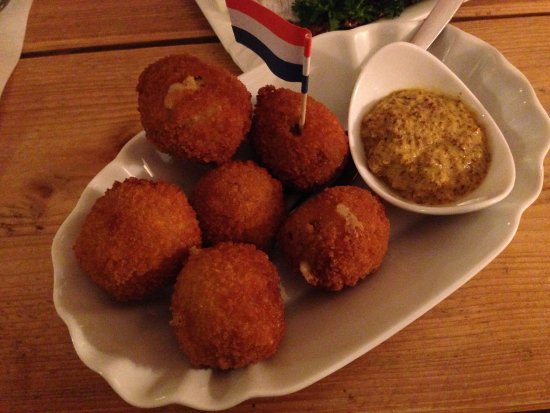
Something like our meatballs. These meat balls are prepared from different varieties of meat and generously picked up with spices. Bitterbollen is often eaten on the street or ordered in bars as an appetizer. But you can see this dish on a traditional Dutch feast during some holiday.

Stamppot
A dish of potatoes that all Dutch respect. In fact, it is mashed potatoes to which cabbage or other vegetables are added. Also, pieces of bacon or sausage often fall into the stamppot. All this is served with piquant sauce. It is worth saying that the dish is very hearty and very inexpensive – a real salvation for a hungry tourist with a small budget.
Klomps, traditional Dutch shoes, are made of wood. Because of this, such shoes weigh a lot, and putting it on a barefoot leg is scary (suddenly a pain?). However, farmers and villagers are still happy to spend their weekdays in them. In general, lovers of colorful folk souvenirs will taste klompas. An alternative to wooden models is soft home slippers of klompo-shaped. Colors and prices are diverse, when buying several pairs at once we recommend trading. In the form of clumps, you can also buy piggy banks, ashtrays and other useful things.
Another symbol of the Netherlands is a mill. Variations in souvenirs with it are hardly less than with shoes. The most common are table mill figures and, of course, magnets. A more original version is earrings and pendants in the form of mills with rotating, albeit even such tiny, blades.
If you are more interested in sex than mills and wooden shoes, safely go to the stores of relevant goods. It is known that in the Netherlands there are a sufficient number. There you will find everything the soul wishes (and, of course, the body): from a huge choice of contraceptives (in taste, color, smell and shape) to the most unimaginable “toys.”
In addition to erotomania, the Netherlands is also famous for its flowers, or more precisely, tulips. Therefore, it is difficult to leave this country without buying some tulip souvenir. The most common is wooden variations on a floral theme, from small vases with three tulips to huge bouquets. Gardeners may be interested in real bulbs of Dutch beauties. However, it is worth noting that the rules for importing such souvenirs into the territory of our country are harsh, so clarify this point in the relevant articles of the law.
The traditional edible souvenir from the Netherlands is cheese. Look for the largest variety of varieties at fairs near cheese auctions, which we previously talked about. You can also visit specialized shops and cheese shops, but there edible souvenirs will cost much more. Do not forget about ordinary grocery stores, let in them you will not find something really original, but you will be able to save and still get a high-quality product.
Jenever (Genevere or simply Jean) is the national Dutch vodka, which is insisted on barley, corn and the obligatory element – juniper berries. It is believed that this is not quite vodka, but rather gin, although the Dutch version differs from the classic English gin in the aroma and flavor of grain raw materials.


18
million
13659
supports
1180
mills
4.2
million
17
century
Bicycles
In the Netherlands, there are more than 18 million bicycles with a population of 16.8 million people
Construction
Royal Palace on Dam Square built on 13,659 wooden supports
Mills
There are 1,180 windmills in the Netherlands
Tourism
Amsterdam is the capital and largest city of the Netherlands. The name of the city comes from the Amstel River, on which Amsterdam is located. About 4.2 million tourists from around the world visit the city every year
Stock exchange
The first stock exchange was opened at the beginning of the 17th century